Stage 1 Presentation
How I Lost 30 Pounds of Lipedema Fat Without Surgery or Exercise
Tami Faris, OT, CLT — FDRS Conference 2024
Video on YouTube: “How I Lost 30 pounds of Lipedema Fat without Surgery or Exercise.”
Text edited from the YouTube transcript by Chuck Ehrlich and Claude AI.
Introduction
My name is Tami Faris. I am an occupational therapist with 27 years of experience and a certified lymphedema therapist for 24 years. This is a case report on how I lost 30 pounds of lipedema fat without surgery or exercise.
Background
Lipedema runs through my family — my grandmothers, great-grandmothers, mother, sister, cousins, and aunt all have it. I have had lipedema since puberty, and like many others, spent my teens and 20s dieting and exercising without lasting results.
In January 2000, at age 27, I completed my lymphedema certification and learned I had lipedema. I was advised to wear compression garments and maintain a healthy body weight. After my pregnancy at age 30, I lost the pregnancy weight through a low-carb, low-calorie diet and exercise. Through my 30s and 40s, I managed to stay within a 10-pound range, but weight loss became increasingly difficult.
Around age 48, my weight crept higher and became harder to control. Knowing menopause was approaching and seeing what had happened to my mother and sister, I was determined to take action. About a year and a half ago, I reached 150 pounds.
Throughout my 24-year career as a certified lymphedema therapist — and as someone living with lipedema — I have attended many conferences and research presentations. I was a co-author on the U.S. Standard of Care for Lipedema in 2019.
In April 2022 at the FDRS Conference in Cleveland, Ohio, I met Dr. Alexander Amato, a vascular surgeon from Brazil. He described treating lipedema by targeting inflammation — using food sensitivity testing, a ketogenic diet, medications as needed — and only performing surgery in his third phase if necessary. His patient outcomes were remarkable. Throughout that conference, the word “inflammation” kept appearing. It inspired me to ask: how can I reduce inflammation throughout my whole body?
Seeking Integrative Care
My primary care physician could not provide the approach I was looking for, so I sought out an integrative medicine clinic staffed by two MDs and a nurse practitioner. I presented them with a thorough overview of lipedema and outlined my goals: assess my labs, test hormone and toxin levels, identify food sensitivities, and support detoxification and hormone balance.
My Health Profile at the Start
At age 50 (now 51), my relevant health history included:
• Stage 1 lipedema (later described as Stage 1.5)
• Estrogen dominance (premenopause)
• No history of hormonal birth control
• Hypothyroidism, controlled by medication
• History of infertility
• History of fibrous breast tissue
• Low vitamin D levels, controlled by supplementation
Results
I lost 30 pounds without surgery and without exercise (I mention this not as a recommendation, but simply because it was not a factor). I went from 150 pounds to 117 pounds. The majority of this weight loss occurred over four months, with gradual loss continuing since. I have maintained this weight for over a year.
Body composition measured by bioimpedance showed that my skeletal muscle mass remained essentially unchanged at approximately 49 pounds, while body fat dropped from nearly 36% to 21.4%. MRI imaging of my calf confirmed a reduction in subcutaneous adipose tissue of nearly 50%, and calf circumference decreased by almost 4 cm at one cross-section — indicative of true lipedema fat loss.
Figure: MRI Images showing the decrease in fat (SAT area) on the left calf between April 2019 and November 2024 while muscle area is largely unchanged.
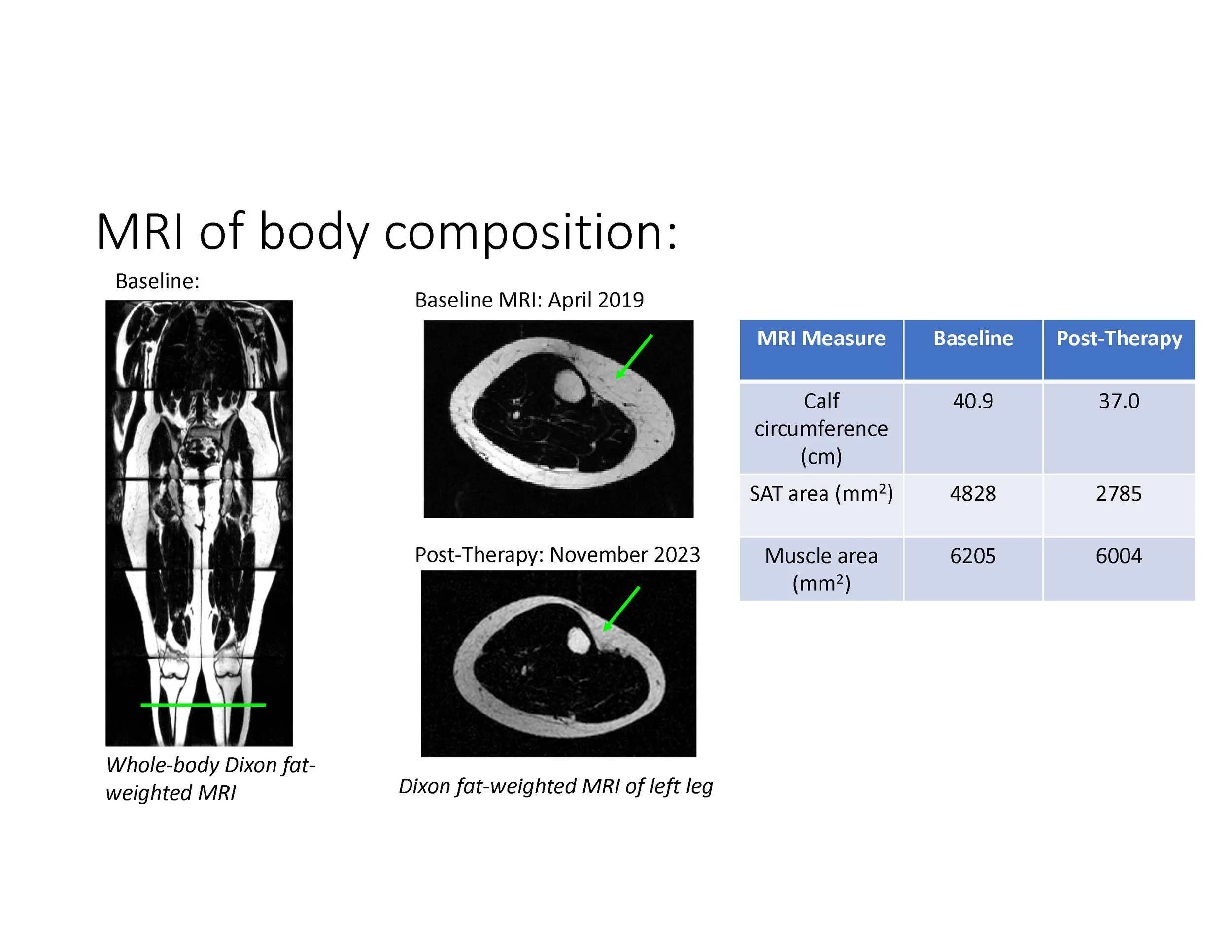
MRI images showing the change in body fat on the left leg from April 2019 to November 2023
MRI images and analysis courtesy of Rachelle L. Crescenzi, PhD, and the SALT Lab https://www.saltmri.com
Treatment Approach
Hormone Therapy
Testing revealed I was estrogen dominant: my estradiol-to-progesterone ratio was 454:1. Free testosterone was nearly undetectable at 0.1 and progesterone was very low (0.3). Treatment focused on reducing estrogen and supporting its elimination, while increasing progesterone and testosterone. By January, my ratio improved to 7.4:1 and free testosterone rose to 1.0. Hormone levels are rechecked every three to four months, and dosing is adjusted accordingly.
Table: Hormone Changes
| May 2022 | Jan 2024 | Ref Range | |
|---|---|---|---|
| Estradiol | 124.9 | 111.3 | 70-300 |
| Progesterone | 0.3 | 15.1 | 1.8-23.9 |
| Free Testosterone | 0.1 | 1.0 | 0.0-4.2 |
| Progesterone/Estradiol | 454 | 7.4 |
Liver Support and Detoxification
To help the liver eliminate excess estrogen and xenoestrogens, I took supplements including calcium D-glucarate, glutathione, milk thistle, and NAC. I also worked to reduce exposure to environmental estrogens (xenoestrogens) such as BPA plastics and fragrances containing phthalates.
Gut Health
Gut dysbiosis causes excess beta-glucuronidase, which leads to estrogen being reabsorbed into the bloodstream. A healthy microbiome supports estrogen elimination. I improved gut health through probiotics, increased fiber and water intake, and a diet focused on reducing inflammation. Adequate fiber and water are especially important for eliminating excess estrogens and toxins from the body.
Nutrition
I made significant dietary changes based on food sensitivity testing and blood glucose monitoring:
Removed gluten and dairy. IgG testing identified dairy as a primary inflammatory trigger; later MRT testing confirmed gluten sensitivity.
Adopted a low-carb, low-cholesterol diet. Replacing keto, which did not work well for me.
Monitored blood glucose with a finger-prick meter — aiming to keep levels in the 70–90 mg/dL range to reduce insulin spikes and aldosterone-driven inflammation
Practiced intermittent fasting, adjusting meal timing based on morning glucose readings
Ate primarily chicken, fish, almonds, olives, vegetables and low-sodium bone broth
Added cayenne pepper to meals and coffee for its metabolism and gut health benefits
Practiced mindful eating: eating slowly, chewing 20–30 times, always sitting down to eat
Infrared Sauna
I used an infrared sauna one to three times per week for detoxification. Research suggests infrared sauna can support cardiovascular health and may mimic the effects of moderate exercise. During a 30-minute session, my heart rate rose from 76 to 111 bpm. It also lowers blood pressure, improves circulation, and supports relaxation. Note: infrared sauna may not be appropriate for individuals with mast cell issues, lymphedema, MS, hypotension, or certain other conditions. Always consult your healthcare provider first.
Meditation and Stress Reduction
Stress triggers histamine release and increases inflammation. It also elevates cortisol, which raises blood sugar and reduces progesterone. I used my sauna time for meditation and prayer. Reducing stress supports adrenal function and helps regulate blood sugar, blood pressure, and sex hormones.
Compression
I have worn compression garments faithfully for 24 years. Research confirms that all stages of lipedema show increased extracellular water, and stage 1 lipedema involves dilated, leaky, and tortuous lymphatic vessels. I used textured compression leggings daily and an intermittent pneumatic compression pump twice a day (morning and evening) to support venous and lymphatic return. After my weight declined, I reduced my compression usage.
Treating Underlying Conditions
Testing revealed that my Epstein-Barr virus (from mono in college) was reactivated and high; I began supplements to suppress it. I also tested positive for Bartonella and received treatment to put it into a dormant state. These underlying infections can drive chronic inflammation. Toxin levels, heavy metals, and mold exposure may also be contributing factors worth investigating.
The Gut–Liver–Hormone Connection
Looking back, everything I did addressed a connected system:
Gut dysbiosis → excess beta-glucuronidase → estrogen reabsorption → estrogen dominance
Liver overload (from xenoestrogens, toxins, poor diet) → impaired estrogen elimination
Estrogen dominance → fat retention, inflammation, hormonal imbalance
Calcium D-glucarate inhibits beta-glucuronidase → supports estrogen excretion
Improved gut microbiome (estrobolome) → better estrogen metabolism
Reduced stress and insulin spikes → lower cortisol and aldosterone → less inflammation
Conclusion
I do not believe any single intervention caused my weight loss — it was the combination of everything working together. The body is a system, and overall balance matters. What worked for me may not work for someone else; we each require an individualized treatment plan.
If your primary care physician cannot support this type of approach, consider seeking out an integrative medicine clinic, functional medicine practitioner, naturopathic doctor, or endocrinologist or gynecologist with a strong background in hormones and supplementation.
My hope is that something I’ve shared gives you the inspiration to try something new.